

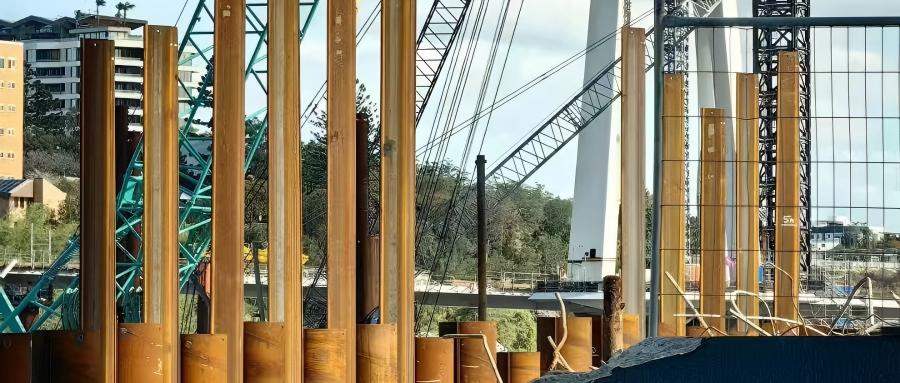
A Combined Steel Wall (tubular Combined pile wall) is a continuous earth- and water-retaining load-bearing wall formed by large-diameter steel pipe king piles interleaved with sheet piles (U- or Z-type), connected through interlocks or welded clutches. The king piles carry bending and vertical loads, while the intermediate sheet piles close the wall and transfer lateral loads to the king piles. This guide helps design offices and procurement teams make sound, compliant and cost-effective selections.
1. What a Combined Wall Is and Where It Applies
Three components define the system: steel pipe king piles (primary load-bearing elements), intermediate sheet piles (retain soil/water and transfer loads), and interlocks/clutches (ensure continuity and shear transfer). A Combined wall is the economical, high-performance alternative when a uniform sheet-pile wall cannot meet capacity, embedment or cut-off demands. Typical uses: quay walls and docks, breakwaters, cofferdams, deep excavations and foundations, road/railway and bridge abutments, and soft or deep soil ground along rivers and coasts.
2. Design Considerations
Start with loads and ground: soil type and bearing, groundwater and tidal range, dredge line and surcharge, staged and accidental (seismic, wave, vessel impact) loads. Soft, deep soils with high head differences are the typical triggers for a Combined wall.
2.1 Load & ground input
2.2 King pile selection
2.3 Intermediate sheet pile selection
2.4 Interlocks and clutches
2.5 Embedment and support system
2.6 Deformation control and stiffness match
2.7 Durability and corrosion protection
2.8 Design codes
2.9 Constructability and tolerances
2.10 Detailing and steel-quantity optimisation
King piles: size diameter, wall thickness and section properties (I, W, A) from the bending envelope and vertical loads; prefer high-strength grades (S355GP / S440GP / S550GP, or ASTM A572 Gr.50) to thin the wall and cut tonnage, and consider concrete-filled piles for extra stiffness and capacity. Sheet piles: common U/Z hot-rolled piles 600–800 mm wide; focus on section modulus, ductility, clutch shear and driveability, co-optimised with king-pile spacing. Clutches transfer shear into the king piles-verify welding method, weld strength, fatigue and drive sequence. Confirm embedment for overturning, heave and global stability, choose cantilever/anchored/strutted support, and verify end-bearing/friction capacity. Match pile and support stiffness to limit lateral movement near existing assets. Select coatings, cathodic protection and corrosion allowance by exposure class (fresh/marine/tidal, chlorides); marine works often Combinedne concrete filling. Follow EN 1993-5, EN 1997, EN 1998, EN 10248, EN 10210/10219 and EN 10204 (or AASHTO, AWS D1.5 and ASTM A252/A500/A572 for US projects). Check hammer access, splices, tolerances, heave and skip-driving, and use PileWallCalc-type tools and BIM to minimise steel per linear metre.
3. Procurement Considerations
Specify EN 10204 3.1 certificates with full traceability (bundle tags and pile markings). Confirm conformance and tolerances: EN 10248-1 for sheet piles, EN 10210/10219 or ASTM for pipe piles. Ensure complete-system supply-king piles, sheet piles and welded clutches from a coordinated source to avoid interlock mismatch and schedule risk. Define fixed lengths, splices and bundling against transport limits; front-load cutting, drilling, clutch welding and coating in the factory. Evaluate on full life-cycle cost rather than tonnage price: high-strength steel raises the unit price but lowers tonnage, transport and driving cost, while reusability and EPD carbon data matter. Prefer suppliers with detailing/OEM-ODM support, third-party inspection (SGS, BV, ABS), NDT and reliable lead times, and require CE/DoP, ETA, MTC and packing lists.
4. Common Pitfalls
· Judging only by tonnage price and ignoring life-cycle cost;
· Splitting king piles, sheet piles and clutches across suppliers;
· Under-designing corrosion protection in tidal/marine zones;
· Skipping vertical-capacity and pile-toe checks;
· Unclear certificates, tolerances and acceptance criteria.
5. FAQ
Q: What is a steel Combined wall?
A: A continuous retaining wall of steel pipe king piles interleaved with sheet piles connected by interlocks or welded clutches.
Q: When to choose a Combined wall over a plain sheet-pile wall?
A: When loads, embedment, head difference or vertical capacity exceed what a uniform sheet-pile wall can handle economically.
Q: Which codes apply?
A: EN 1993-5 / 1997 / 1998, EN 10248 / 10210 / 10219, EN 10204; AASHTO, AWS D1.5 and ASTM for US projects.
Q: Which steel grades are common?
A: Pile steels S355GP / S440GP / S550GP, or ASTM A572 Gr.50, A252, A500; higher grades reduce thickness and weight.
Q: How to optimise steel per linear metre?
A: Combinedne high-strength grades, co-optimised pile spacing and detailing via BIM to minimise kg/m.
6. About Sunlion
Sunlion Piping Engineering Co., Ltd. offers a vertically integrated supply chain from raw materials to finished modules, supplying pipe king piles, sheet piles, clutches and detailing support for Combined wall systems worldwide. Contact us for a tailored selection and quotation for your project.


